Here I go again, going out on a limb again because there is so little information coming out of the '300' camp. For example, as of this day we still don't know the roles that David Wenham and Dominic West will be playing and they were named to the cast months ago! Occasionally, someone involved in the movie in some capacity will anonymously leave a comment for which I am extremely grateful.
The only analogy I can use is, I've got the borders of the jigsaw puzzle completed, however, I'm missing the majority of the pieces and once in a while I'll find one here and there. To illustrate this point, several weeks ago, a source let me know that the Spartans wouldn't have crests on their helmets as illustrated in the Frank Miller comics. He hadn't seen Gerry Butler in his helmet, therefore, he couldn't let me know if there would be a crest on the helmet of King Leonidas.
I know, I know, what's the big deal, right? Well, one of the criticisms of 'The 300 Spartans' was why did Richard Egan and the cast of the Spartans that had speaking roles have different helmets than the rest of the extras that had non-speaking parts? The answer is: how were you going to identify the stars if they weren't easily recognizable? This brings us to '300' and why I believe that King Leonidas (Gerry Butler) and several of his subordinates will be wearing a helmet which is different than the rest of the cast.
Where is the Cobra when you need him???
Wednesday, November 30, 2005


Tuesday, November 29, 2005
Blog Number 78 - An illustration of the final day of the '300' Spartans
 This is a fantastic illustration from Peter Connolly's book 'Greece and Rome at War' which shows the start of battle on the final day of Thermopylae. When it became apparent to King Leonidas that the Greek forces would be surrounded, he led the remaining troops to the widest part of the pass so that he could inflict the greatest amount of casualties. It was during this part of the battle that he ended dying and for which both the Greeks and Persians fought bitterly to take possession of his body.
There will be many memorable scenes in this movie and I believe that the final day of Thermopylae will be one of Gerry Butler's shining moments in '300'.
Monday, November 28, 2005
Blog Number 77 - The present day Thermopylae of Frank Miller's '300'
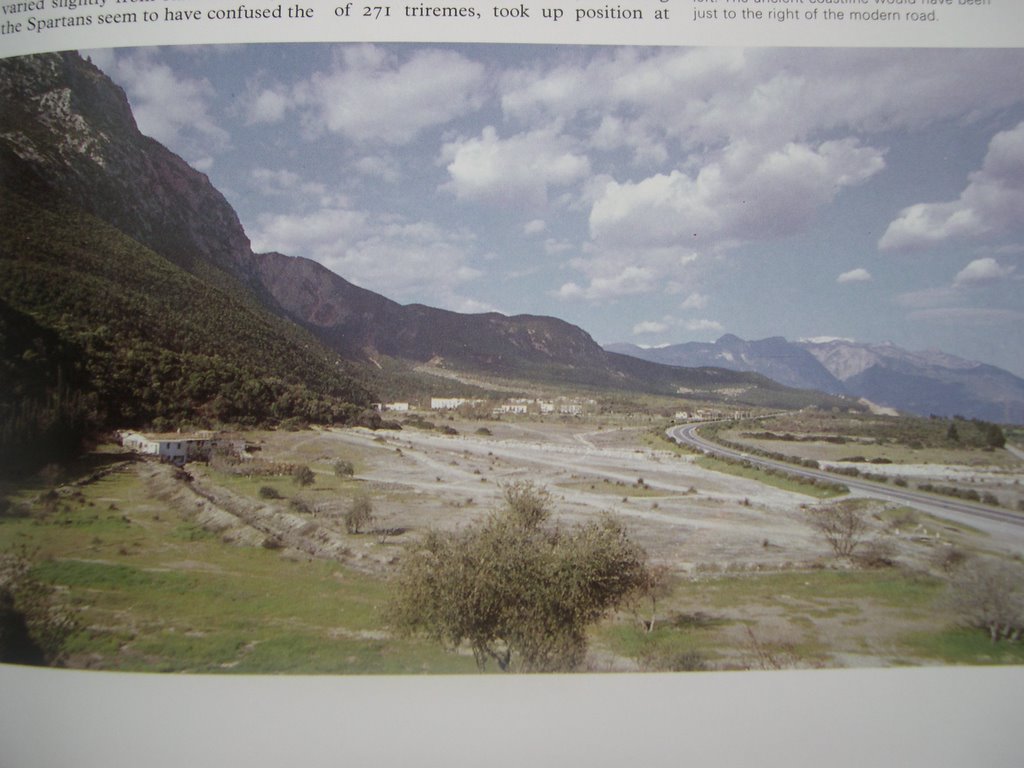 Here is an image from Peter Connolly's book 'Greece and Rome at War' which shows how Thermopylae looks today and how it has changed dramatically. According to Herodotus, the ancient coastline would have been to the right of the modern road, which have made the pass about 50 feet wide.
For comparative purposes, I reference the painting by Stanley Meltzoff included in Blog Number 24 as the reason for being a proponent of CGI. If you look to the background of the Meltzoff image, it will illustrate how narrow the pass of Thermopylae was and how few men could actually traverse the pass at a given time. Therefore, Zack Snyder and the technicians involved will be able to recreate the battlefield so that it resembles the terrain as how it appeared in 480 B.C. which will be one of the benefits of computer-generated imagery.
Thanks Sadieanne!
Sunday, November 27, 2005
Blog Number 76 - Pronunciation of Xerxes' name in Frank Miller's '300'
Since my last several blogs have been about Xerxes, the King of Persia, I thought it would be appropriate to list his name phonetically for those who haven't seen 'The 300 Spartans'. While the aforementioned movie had several different pronunciations of King Leonidas' name, Xerxes' name was pronounced consistently throughout.
Phonetically, the pronunciation is Zer-xees and as I mentioned in my last blogs, the Persian king will be portrayed by Brazilian actor Rodrigo Santoro.
Thanks, Lori
Phonetically, the pronunciation is Zer-xees and as I mentioned in my last blogs, the Persian king will be portrayed by Brazilian actor Rodrigo Santoro.
Thanks, Lori
Saturday, November 26, 2005
Blog Number 75 - Brazilian actor Rodrigo Santoro as Xerxes in Frank Miller's '300'
 Once Scottish actor Gerard Butler was announced as having been chosen to play King Leonidas in Frank Miller's '300', I wondered what actor would portray his nemesis, King Xerxes of Persia. I had read a Zack Snyder interview where he said that they had worked on a model of Ephialtes that conformed to the comic book version, which meant that if they stayed consistent, the appearance of the characters would conform to Frank Miller's illustrations.
Which brings us to the character of King Xerxes! One of the interesting names that I had seen being thrown around by the Frank Miller fans as to whom they wanted to play Xerxes was that of Laurence Fishburne who played Morpheus in the Matrix trilogy and who did resemble the Miller illustration. Another choice mentioned was that of Obed Fehr who played Ardeth Bey in 1999's 'The Mummy', however, in my opinion, he looked more like David Farrar's Xerxes in 'The 300 Spartans'.
Then out of nowhere came the announcement that Brazilian actor Rodrigo Santoro had been cast as Xerxes. If you had noticed the announcements so far, each of the actors had either an English/Scottish/Irish/Australian accent. However, for those who have reservations about Santoro, his accent in 'Love Actually' should dispel any qualms about whether or not he will be able speak like the rest of the cast.
Friday, November 25, 2005
Blog Number 74 - Xerxes in Frank Miller's '300'
The character in Frank Miller's '300' that I found the most intriguing next to Ephialtes was that of Xerxes, the king of Persia. It wasn't King Leonidas for the reason that Frank Miller's version of the King of Sparta encompassed all the virtues that I had seen in 'The 300 Spartans' and in all of the books that I had read. Specifically, it was the illustrations of Xerxes which made me take notice and while they weren't as startling as the appearance of Ephialtes, they differed greatly from the images of the Persian king that I had seen.
It was a combination of the shaved head, body piercings and the Nubian-like appearance which seemed so enthralling. Once again, I was perplexed as to why Frank Miller had taken a character so deeply ingrained in the psyche of those of us who had seen the movie 'The 300 Spartans' and radically altered his appearance.
The only theory that I could come up with was that since Xerxes led an army comprised of 46 nations spread over three continents, his appearance was a composite of the multicultural forces that he commanded.
It was a combination of the shaved head, body piercings and the Nubian-like appearance which seemed so enthralling. Once again, I was perplexed as to why Frank Miller had taken a character so deeply ingrained in the psyche of those of us who had seen the movie 'The 300 Spartans' and radically altered his appearance.
The only theory that I could come up with was that since Xerxes led an army comprised of 46 nations spread over three continents, his appearance was a composite of the multicultural forces that he commanded.
Thursday, November 24, 2005
Blog Number 73 - Ephialtes in Frank Miller's '300'
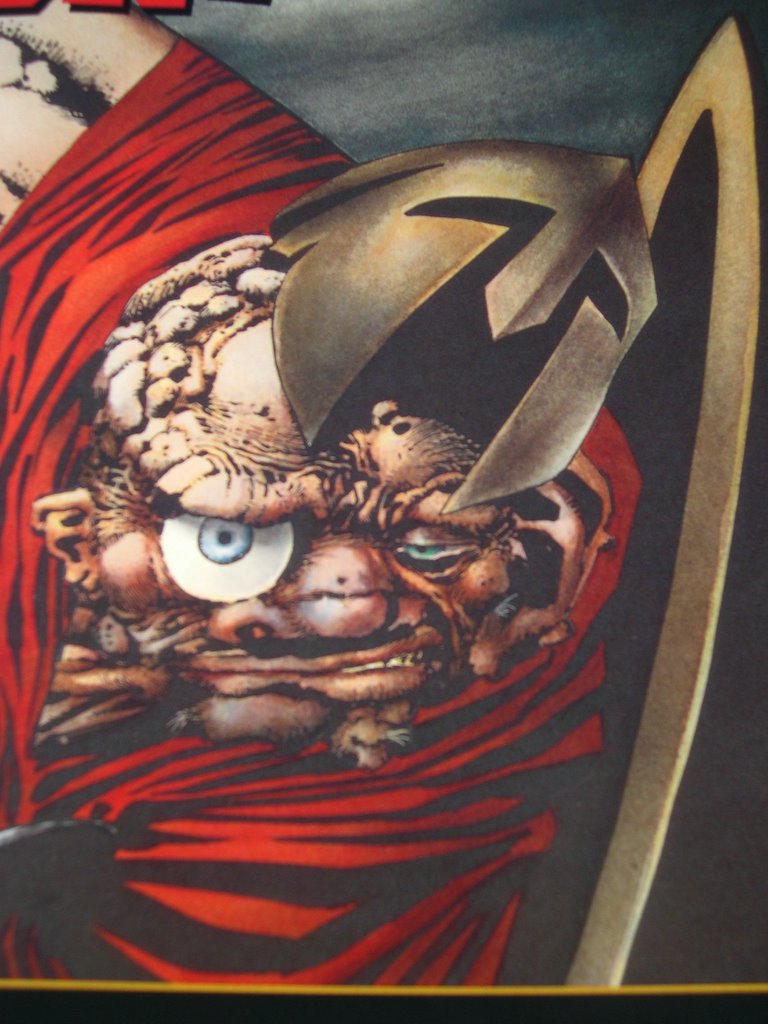 It was reported several weeks ago that the role of Ephialtes would be played by British actor Andrew Tiernan. Zack Snyder who is the director of '300' said in an interview last year that they had worked on a maquette that looked exactly like the character as illustrated by Frank Miller. Therefore, we can only assume that Ephialtes will appear as he does in this image and that Andrew Tiernan will have to endure hours sitting in a chair while they prep him for all the prosthetics and makeup.
Let's not forget the artists whose skills prepare the actor so that they appear according to the director's vision. Even the most subtle application of sweat, dirt, blood, etc. provides the realism which is needed. It is almost too easy to see the character as a 'finished product' and to forget the hundreds of hours that are spent getting the characters ready for how they will appear on camera.
I tip my hat off to the artists behind the scenes and hope that some of their magic is made available as extras on the DVD!
Wednesday, November 23, 2005
Blog Number 72 - An illustration of the '300' Spartans at Thermopylae
 Here is an image of the Battle of Thermopylae by the renowned illustrator J. Steeple Davis. This illustration reflects the vantage point of the Persian army and while the landscape depicted is incorrect, it does provide that claustrophobic feeling that must have been prevalent amongst the warriors on both sides. The Pass of Thermopylae was chosen as the battlefield by Greece because according to Herodotus it was approximately 50 feet wide in 480 B.C., which would have reduced the effectiveness of the much larger enemy force.
With CGI, the landscape of the battlefied at Thermopylae can be duplicated so that it looks like it did 2,500 years ago which would be phenomenal!
Tuesday, November 22, 2005
Blog Number 71 - A different illustration of death of the Persian messengers in Frank Miller's '300'
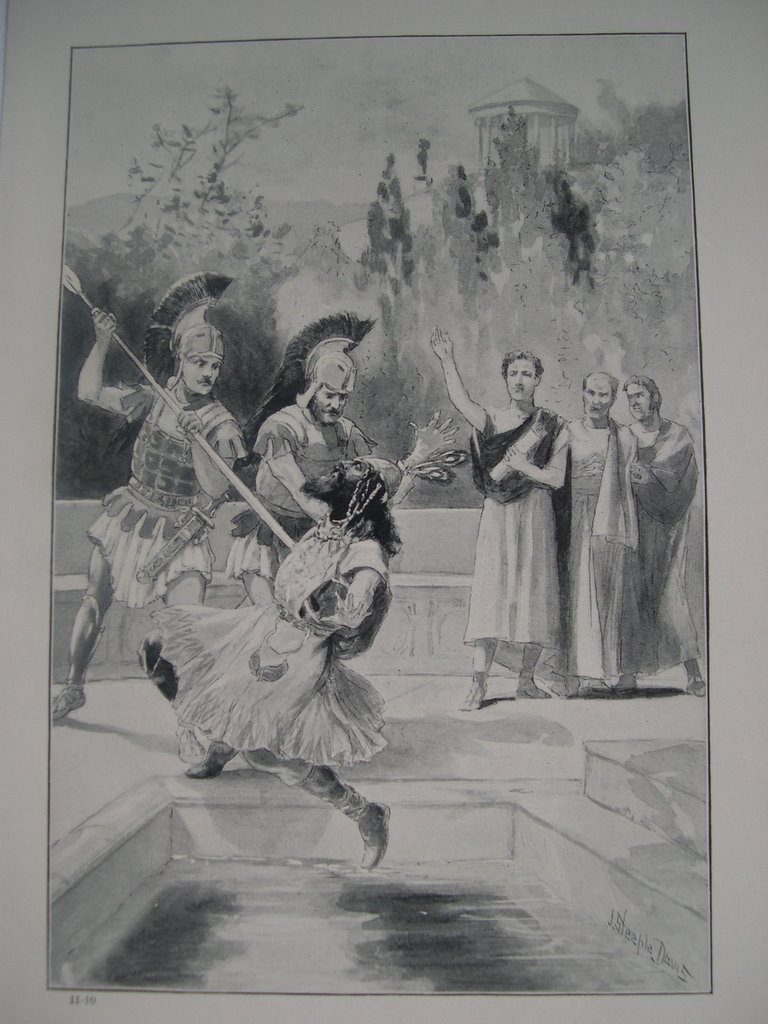 Here is an image of a print illustrated by J. Steeple Davis which is similar to Frank Miller's version from Blog Number 70. While they are depicting the same event, it is difficult to say which one I prefer. Is it the b&w Davis illustration or the Frank Miller version which was colored by Lynn Varley and included in the previous blog?
Monday, November 21, 2005
Blog Number 70 - Death of the Persian messengers in Frank Miller's '300'
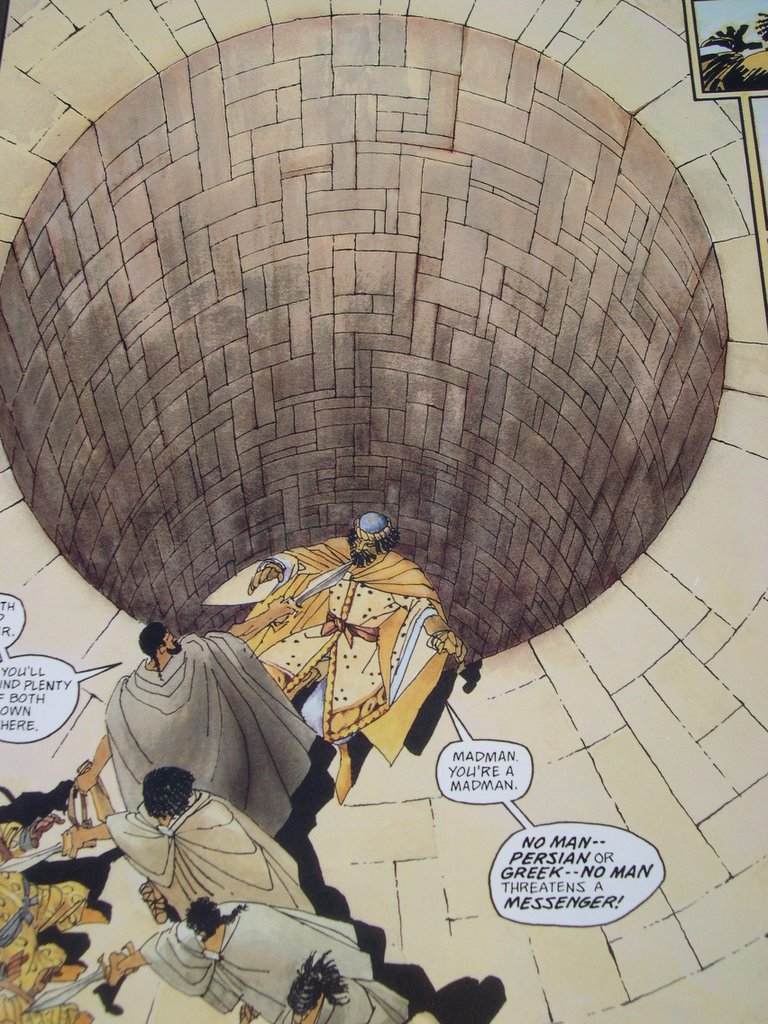 In Blog Number 55, Frank Miller talked about how even though he took some creative liberties when writing '300', part of it was based on fact. To illustrate this point, here is the image of the Persian ambassador being thrown into the well by King Leonidas. This was the response by the Spartan king in '300' when he was asked for earth and water which were symbols of submission.
According to Herodotus, heralds were not sent to Sparta and Athens by Xerxes as was the case a decade earlier. When Xerxes' father Darius had sent his emissaries to Sparta and Athens before the invasion of Marathon in 490 B.C. they had been thrown into a well by the Spartans and a pit by the Athenians.
I wonder if this is the derivation of 'Don't kill the messenger', probably not, though!
Sunday, November 20, 2005
Blog Number 69 - Unconfirmed report on the filming location of Frank Miller's '300'
One of the nice features of Blogger is that it allows readers to leave comments which I always appreciate since it invariably provides me with an idea or two for my next blog. I've also received comments from others who have let me know before it was announced that Andrew Pleavin would be portraying Daxos (the leader of the Arkadians) and that the Spartans would be portrayed without crests on their helmets, etc.
Several weeks ago, I received an anonymous comment which an individual left on Blog Number 49 which stated that '300' would be filmed at Mel's Cité du Cinéma. It was extensively reported by the Canadian media and other outlets that Ben Stiller's 'Night at the Museum' was to be filmed in Montreal at Mel's, however, that never came to fruition because Stiller's filming location changed to Vancouver. This could also account for the initial reports which turned out to be erroneous that '300' was to be filmed in Vancouver, however, it was later learned that '300' began filming in Montreal. Could this have been a classic case of mistaken locations? '300' went from being filmed in Vancouver to Montreal and 'Night at the Museum' from Montreal to Vancouver. Very interesting!!!
A search revealed that Mel's is a sprawling complex of studios and facilities spread out over different locations. Therefore, in all probability, director Zack Snyder, Gerry Butler and all those involved in the filming of Frank Miller's '300' could still be in one of the Mel's locations. Of course the $64,000 question is 'Which one?'
Several weeks ago, I received an anonymous comment which an individual left on Blog Number 49 which stated that '300' would be filmed at Mel's Cité du Cinéma. It was extensively reported by the Canadian media and other outlets that Ben Stiller's 'Night at the Museum' was to be filmed in Montreal at Mel's, however, that never came to fruition because Stiller's filming location changed to Vancouver. This could also account for the initial reports which turned out to be erroneous that '300' was to be filmed in Vancouver, however, it was later learned that '300' began filming in Montreal. Could this have been a classic case of mistaken locations? '300' went from being filmed in Vancouver to Montreal and 'Night at the Museum' from Montreal to Vancouver. Very interesting!!!
A search revealed that Mel's is a sprawling complex of studios and facilities spread out over different locations. Therefore, in all probability, director Zack Snyder, Gerry Butler and all those involved in the filming of Frank Miller's '300' could still be in one of the Mel's locations. Of course the $64,000 question is 'Which one?'
Saturday, November 19, 2005
Blog Number 68 - The '300' Spartans and the 700 Thespians
The military precision and effectiveness of the Spartan phalanx combined with the tenacity of the Spartan warriors which had been instilled since their youth, made Sparta the preeminent warrior state in Ancient Greece. It was this reputation that preceded the 300 Spartans before they arrived at Thermopylae and which together with their heroic self-sacrifice in 480 B.C. became part of the Spartan legend.
In '300', Frank Miller mentions the Thespian warriors and other Greek hoplites that fought at Thermopylae and while the Thespian contribution to Thermopylae has not been totally overlooked, it has been easier to minimize because of the overwhelming Spartan superiority as described above.
What should be known is that the city of Thespiae sent the majority of her army which was comprised of 700 hoplites and who together with the remaining Spartans fought to the bitter end at Thermopylae. For this action, the city of Thespiae received the same fate as the city of Athens by being burned to the ground.
Therefore, my belief is that the Thespians should be held in the highest esteem as the Spartan fallen. After all, they were given an opportunity to leave, however, they distinguished themselves by remaining to fight and die with the remaining Spartan heroes.
In '300', Frank Miller mentions the Thespian warriors and other Greek hoplites that fought at Thermopylae and while the Thespian contribution to Thermopylae has not been totally overlooked, it has been easier to minimize because of the overwhelming Spartan superiority as described above.
What should be known is that the city of Thespiae sent the majority of her army which was comprised of 700 hoplites and who together with the remaining Spartans fought to the bitter end at Thermopylae. For this action, the city of Thespiae received the same fate as the city of Athens by being burned to the ground.
Therefore, my belief is that the Thespians should be held in the highest esteem as the Spartan fallen. After all, they were given an opportunity to leave, however, they distinguished themselves by remaining to fight and die with the remaining Spartan heroes.
Friday, November 18, 2005
Blog Number 67 - Another image of armor worn by the '300' Spartans
 Here is another fantastic illustration from John Warry's book entitled 'Warfare in the Classical World'. This warrior has a transverse crest on his helmet which was believed to signify that the hoplite was either a king or an officer of the Spartiates.
When I read first '300', what struck me was that only King Leonidas' helmet had a crest and the other Spartans didn't. It was confirmed by COBRA that the Spartans in the cast will not have a crest on theirs! I'm still waiting for those photos mate (300blogspot@comcast.net)! Cheers!!!
Thursday, November 17, 2005
Blog Number 66 - CGI (Computer Generated Imagery) in Frank Miller's '300'
I recently read that the budget for Frank Miller's '300' is $70 million instead of the $60 million which had been originally reported. Was Zack Snyder provided an additional $10 million to the budget, or does he still only have the $60 million that he had been allotted? Either way, since the stylized 'Sin City' was in the $40 million range, it boggles the mind to think what can be done with $60 million, let alone $70 million!
There can be no replacement for filming at the actual location of Thermopylae, however, this is unfeasible now because the landscape has changed so much in over 2,500 years. It would also be impracticable to feed and to provide uniforms to a thousand, let alone, hundreds of thousands of extras. The logistics and cost alone would rival those of the Persian army amassed by Xerxes in 480 B.C.
Therefore, I believe that CGI is the solution to the aforementioned dilemma. All the artists and technicians involved will be able to duplicate the landscape and the huge Persian army with no problem whatsoever!!!
There can be no replacement for filming at the actual location of Thermopylae, however, this is unfeasible now because the landscape has changed so much in over 2,500 years. It would also be impracticable to feed and to provide uniforms to a thousand, let alone, hundreds of thousands of extras. The logistics and cost alone would rival those of the Persian army amassed by Xerxes in 480 B.C.
Therefore, I believe that CGI is the solution to the aforementioned dilemma. All the artists and technicians involved will be able to duplicate the landscape and the huge Persian army with no problem whatsoever!!!
Wednesday, November 16, 2005
Blog Number 65 - Filming dates for Frank Miller's '300'
According to the Montreal Film Resources, the filming dates for Frank Miller's '300' are from October 17, 2005 through January 25, 2006 and will be shot mainly in CGI.
Tuesday, November 15, 2005
Blog Number 64 - The Stax Report's review of Michael Gordon's draft of Frank Miller's '300'
The last four blogs that I have posted have all made reference to Stax's review of the Michael Gordon adaptation of Frank Miller's '300'. While I have commented on several of the scenarios which appeared in the draft and which I hope come to fruition, the truth of the matter is that they probably won't see the light of day. Here's to wishful thinking, since as Stax mentioned to me the other day, Zack Snyder and Kurt Johnstad had written a new script which is being used for the movie.
I thought that I should provide the link to Stax's review so that you could see that Michael Gordon had some pretty good ideas. I still feel that because of the genesis of several characters and scenes that at least some part of Gordon's draft has been encompassed within the Snyder/Johnstad framework.
I thought that I should provide the link to Stax's review so that you could see that Michael Gordon had some pretty good ideas. I still feel that because of the genesis of several characters and scenes that at least some part of Gordon's draft has been encompassed within the Snyder/Johnstad framework.
Monday, November 14, 2005
Blog Number 63 - Zack Snyder's script for Frank Miller's '300'
When Zack Snyder was interviewed last year he said that '300' would have more 'girl-power'. On the surface, this seemed to detract from Frank Miller's version of the events on the Battle of Thermopylae, however, this only reinforces my opinion that the story will encompass much more than 300 Spartan warriors fighting against the Persian army.
Let us go under the assumption that Michael Gordon's second draft as reviewed in the Stax Report is indicative of the role that Lena Headey will assume as Gorgo, the Queen of Sparta. It will differ greatly from the part played by the Greek actress Anna Synodinou in 'The 300 Spartans' who even though majestic in her appearance, was relegated to few lines of dialogue.
Let us go under the assumption that Michael Gordon's second draft as reviewed in the Stax Report is indicative of the role that Lena Headey will assume as Gorgo, the Queen of Sparta. It will differ greatly from the part played by the Greek actress Anna Synodinou in 'The 300 Spartans' who even though majestic in her appearance, was relegated to few lines of dialogue.
Sunday, November 13, 2005
Blog Number 62 - More thoughts on Michael Gordon's draft of Frank Miller's '300'
Last year, the Stax Report posted a review of Michael Gordon’s draft which was based on the Frank Miller Battle of Thermopylae comic book series ‘300’. This draft was superceded by director Zack Snyder & Kurt Johnstad’s version, however, since credit is still being given to the author of the original draft, I believe that Snyder & Johnstad probably retained the integrity of several of the passages along with the development of several of the characters as first written by Gordon.
In the original draft, Artemis who is the ‘Captain’, is the father of the young Spartan warrior Stelios (Stumblios) and the brother to King Leonidas. Therefore, as I mentioned in my previous post, there are several nuances which I hope they keep for the following reason.
According to Herodotus, there were two Spartan warriors who survived the Battle of Thermopylae. Also, in the 1962 movie, ‘The 300 Spartans’ the Spartan warrior Phylon who is the fiancé of King Leonidas’ niece Ellas, is the sole survivor of the battle since he is ordered to carry a message back to Sparta.
I know I’m taking a chance here, however, as an homage to the movie ‘The 300 Spartans’ which was the inspiration for Frank Miller’s ‘300’, I believe that Michael Fassbender who plays Stelios will be the one Spartan warrior who survives the battle. It will befitting as a conclusion to the movie, to show the battle hardened Stelios leading other Spartiates at Plataea and avenging his father and uncle’s death.
Do you think any of the 300 Spartans will survive?
In the original draft, Artemis who is the ‘Captain’, is the father of the young Spartan warrior Stelios (Stumblios) and the brother to King Leonidas. Therefore, as I mentioned in my previous post, there are several nuances which I hope they keep for the following reason.
According to Herodotus, there were two Spartan warriors who survived the Battle of Thermopylae. Also, in the 1962 movie, ‘The 300 Spartans’ the Spartan warrior Phylon who is the fiancé of King Leonidas’ niece Ellas, is the sole survivor of the battle since he is ordered to carry a message back to Sparta.
I know I’m taking a chance here, however, as an homage to the movie ‘The 300 Spartans’ which was the inspiration for Frank Miller’s ‘300’, I believe that Michael Fassbender who plays Stelios will be the one Spartan warrior who survives the battle. It will befitting as a conclusion to the movie, to show the battle hardened Stelios leading other Spartiates at Plataea and avenging his father and uncle’s death.
Do you think any of the 300 Spartans will survive?
Saturday, November 12, 2005
Blog Number 61 - Michael Gordon's characterization of Stelios & the 'Captain'
According to the Stax Report, Michael Gordon's draft of Frank Miller's '300' which was dated May 22, 2003 had several major differences from the novel. The one which I will explore today is that the 'Captain' as written in Gordon's draft was the father of the young warrior Stelios.
Stelios if you haven't read '300' is nicknamed 'Stumblios' because he falls (stumbles) on his way to the battlefield of Thermopylae. For this 'misstep', he is severely disciplined almost to the point of death by the Spartan officer 'Captain' before he is is rescued by King Leonidas who will be portrayed by Scotsman Gerry Butler.
As I mentioned, the most interesting part of Gordon's '300' draft, was that the 'Captain' was Stelios' father. If this familial bond is kept intact in the movie, this would emphatically make the point that there wasn't any nepotism in the Spartiati ranks and which would only serve to reinforce the renowned Spartan toughness.
The role of the 'Captain' & 'Stelios', will be played by Vincent Regan and Michael Fassbender, respectively and I for one hope that this is one part of Gordon's draft which remains untouched for the aforementioned reason.
Stelios if you haven't read '300' is nicknamed 'Stumblios' because he falls (stumbles) on his way to the battlefield of Thermopylae. For this 'misstep', he is severely disciplined almost to the point of death by the Spartan officer 'Captain' before he is is rescued by King Leonidas who will be portrayed by Scotsman Gerry Butler.
As I mentioned, the most interesting part of Gordon's '300' draft, was that the 'Captain' was Stelios' father. If this familial bond is kept intact in the movie, this would emphatically make the point that there wasn't any nepotism in the Spartiati ranks and which would only serve to reinforce the renowned Spartan toughness.
The role of the 'Captain' & 'Stelios', will be played by Vincent Regan and Michael Fassbender, respectively and I for one hope that this is one part of Gordon's draft which remains untouched for the aforementioned reason.
Friday, November 11, 2005
Blog Number 60 - Michael Gordon's screenplay for Frank Miller's '300'
In 2003, Michael Gordon had written a draft for Frank Miller's '300', which in February 2004, reviewer extraodinaire Stax had written a column about for IGN Entertainment. When the news was confirmed that '300' would begin filming, it was publicized that Zack Snyder and Kurt Johnstad had adapted their screenplay from Miller's graphic novel. However, according to IMDB, Snyder, Johnstad, Frank Miller and interestingly enough Michael Gordon have received writing credits.
So, here's my take on what has happened, therefore, I could be way off base! Even though Zack Snyder & Kurt Johnstad have used their script for the filming of '300', evidently there are elements of Michael Gordon's draft that are incorporated into their script. Then again, it is possible that there are re-writes still occurring as we speak, which can sometimes go on even until the 11th hour. However, I believe that there are several elements in Gordon's draft which must have been too good not to include.
The questions which beckon are, was it a new character that was introduced who was not in Frank Miller's '300', was it an existing character who was developed more completely, or was it the battle scenes which were more fully realized?
I would love to read Gordon's original draft and even the script which has superceded it to make that comparison!
So, here's my take on what has happened, therefore, I could be way off base! Even though Zack Snyder & Kurt Johnstad have used their script for the filming of '300', evidently there are elements of Michael Gordon's draft that are incorporated into their script. Then again, it is possible that there are re-writes still occurring as we speak, which can sometimes go on even until the 11th hour. However, I believe that there are several elements in Gordon's draft which must have been too good not to include.
The questions which beckon are, was it a new character that was introduced who was not in Frank Miller's '300', was it an existing character who was developed more completely, or was it the battle scenes which were more fully realized?
I would love to read Gordon's original draft and even the script which has superceded it to make that comparison!
Thursday, November 10, 2005
Blog Number 59 - More casting news in Frank Miller's '300'
Even more casting news from IMDB in that Englishman Dennis St. John will portray 'The Spartan Baby Inspector' and local Canadian Maurizio Terrazzano has been cast as the 'Sentry' in Frank Miller's '300'.
In my opinion, the casting of these roles offers one of the most encouraging signs to date, since it now appears that this movie will introduce characters and incorporate elements not included in the '300' book. Of course, there is always the possibility that the scenes involving the aformentioned characters could wind up on the cutting room floor, however, that appears unlikely.
One of the criticisms that had been voiced is that due to the length of the 5-part comics, it was believed that if the movie mirrored Miller's comics there wouldn't be enough content to make an entertaining movie of any length. However, that criticism seems to be unjustified since new characters have been introduced, with the possibility of more, which is a significant development.
In my opinion, the casting of these roles offers one of the most encouraging signs to date, since it now appears that this movie will introduce characters and incorporate elements not included in the '300' book. Of course, there is always the possibility that the scenes involving the aformentioned characters could wind up on the cutting room floor, however, that appears unlikely.
One of the criticisms that had been voiced is that due to the length of the 5-part comics, it was believed that if the movie mirrored Miller's comics there wouldn't be enough content to make an entertaining movie of any length. However, that criticism seems to be unjustified since new characters have been introduced, with the possibility of more, which is a significant development.
Wednesday, November 09, 2005
Blog Number 58 - Andrew Tiernan cast as Ephialtes in Frank Miller's '300'
The latest news according to IMDB has British actor Andrew Tiernan assuming the role of Frank Miller's hunchback Ephialtes in '300'. What is interesting is that even though Dominic West and David Wenham's announcement to the cast of '300' has preceded that of Andrew Tiernan's inclusion by several weeks, their roles haven't been revealed as of yet, which has created even more speculation as to whom that they will be portraying.
It seems that now since the role of Ephialtes has been cast, the only other character from '300' who has yet to be named is Dilios the storyteller, which seems to be tailor-made for the Aussie Wenham.
It seems that now since the role of Ephialtes has been cast, the only other character from '300' who has yet to be named is Dilios the storyteller, which seems to be tailor-made for the Aussie Wenham.
Tuesday, November 08, 2005
Blog Number 57 - Dark Horse Comics - History of the Greek-Persian Wars - Part III of III - Frank Miller's '300'
There was a synopsis of the the second invasion of the Greek-Persian Wars which appeared in 1998 on the Dark Horse Comics website. Interspersed within was a Frank Miller interview which was conducted to publicize the release of the '300' comic book series. Due to the length of the article, I took the liberty of breaking it down into three segments.
Below is Part III of III:
In mid-August of the same year, at a time when most Greek city-states were withdrawing from their holding positions for religious observation of the Carneia and for Olympic competitions, a small force of 300 Spartans, led by King Leonidas, marched north to Thermopylae to fortify that important pass. This force was reinforced by factions from neighboring cities, but the total number of Greeks involved never topped seven thousand.
While the Persian navy was suffering formidable losses at sea due to a terrible storm and the subsequent attack of the Athenian navy, Xerxes ordered his land troops forward to attack the Spartan's defense of the Hot Gates at Thermopylae. For the first two days of the battle at Thermopylae, the Persians were badly defeated by the steadfast Spartan-led troops, but on the third day, Xerxes' imperial guard found access to a previously undiscovered pass (revealed to them by a turn-coat Greek) that allowed them to outflank Leonidas' guard. Xerxes ordered yet another frontal attack -- of the same caliber that had been defeated the previous two days -- but this time, he also commanded a second attack from the rear mountain pass. Leonidas and his Spartans were defeated after two glorious days of battle, and Xerxes' troops eventually advanced into Southern Greece, despite the heavy losses dealt by the 300 Spartans.
The following year was tumultuous for the allied Greek states, as the invaders took Attica, and the Acropolis at Athens fell to Persian troops. Nevertheless, Greece managed to prevail over the tiring Persians in key battles, and by late 479, a fortified alliance between the remaining Spartan forces and Athens proved formidable enough to reclaim the lost Greek territories and defeat Persia.
Revisit this most remarkable and under-reported battle of the Persian invasion of Greece with Frank Miller's latest Dark Horse series, 300.
Below is Part III of III:
In mid-August of the same year, at a time when most Greek city-states were withdrawing from their holding positions for religious observation of the Carneia and for Olympic competitions, a small force of 300 Spartans, led by King Leonidas, marched north to Thermopylae to fortify that important pass. This force was reinforced by factions from neighboring cities, but the total number of Greeks involved never topped seven thousand.
While the Persian navy was suffering formidable losses at sea due to a terrible storm and the subsequent attack of the Athenian navy, Xerxes ordered his land troops forward to attack the Spartan's defense of the Hot Gates at Thermopylae. For the first two days of the battle at Thermopylae, the Persians were badly defeated by the steadfast Spartan-led troops, but on the third day, Xerxes' imperial guard found access to a previously undiscovered pass (revealed to them by a turn-coat Greek) that allowed them to outflank Leonidas' guard. Xerxes ordered yet another frontal attack -- of the same caliber that had been defeated the previous two days -- but this time, he also commanded a second attack from the rear mountain pass. Leonidas and his Spartans were defeated after two glorious days of battle, and Xerxes' troops eventually advanced into Southern Greece, despite the heavy losses dealt by the 300 Spartans.
The following year was tumultuous for the allied Greek states, as the invaders took Attica, and the Acropolis at Athens fell to Persian troops. Nevertheless, Greece managed to prevail over the tiring Persians in key battles, and by late 479, a fortified alliance between the remaining Spartan forces and Athens proved formidable enough to reclaim the lost Greek territories and defeat Persia.
Revisit this most remarkable and under-reported battle of the Persian invasion of Greece with Frank Miller's latest Dark Horse series, 300.
Monday, November 07, 2005
Blog Number 56 - Dark Horse Comics - History of the Greek-Persian Wars - Part II of III - Frank Miller's '300'
There was a synopsis of the the second invasion of the Greek-Persian Wars which appeared in 1998 on the Dark Horse Comics website. Interspersed within was a Frank Miller interview which was conducted to publicize the release of the '300' comic book series. Due to the length of the article, I took the liberty of breaking it down into three segments.
Below is Part II of III:
An early history of the rise of Persia and its great King Xerxes reveals a relatively rapid growth of the Persian empire. The empire was founded around 550 B.C. by Cyrus the Elder, who in a very short time managed to incorporate Babylon, Syria, Phoenicia, and every other land adjacent to Persia into the growing nation. Within twenty years, Cambyses, who succeeded Cyrus in Persia's rule, incorporated Egypt into the empire, and with another twenty years, then-Persian leader Darius established a firm bridge-head into Greece by conquering and claiming both Scythia and Thrace. By the time the great Xerxes took reign of Persia, some sixty-five years after its founding by Cyrus, Greece had already defeated the expanding empire during one attempted invasion, and was steeling itself against any further attacks. And further attacks were a guaranteed prospect, given the Persian army's unprecedented numbers.
Despite the strength of the individual Greek societies at this time, there was not yet any notion of there being a Greek nation. Athens was inarguably the most sophisticated of the city-states, but Sparta, with its almost primal customs and infused warrior mentality acted as a great potential threat against the advancing Persians. In the face of the imminent Persian invasion, a makeshift alliance grew between the Greek states, loosely uniting the strong Athenian navy, the vicious Spartans, who knew the intimidating Greek terrain better than anyone else, and various factions from smaller cities.
Still, problems arose between the more academic and civilized Athenians and their Spartan counterparts. Since Athens had by far contributed the most troops to the confrontation, Athenians understandably wanted their leader Themosticles named commander-in-chief. Sparta, on the other hand, claimed superior knowledge of battle and warfare, therefore its preferred leader was the Spartan Eurybiades. An informal resolution named Eurybiades admiral, despite the widely recognized fact that Themosticles made most of the pertinent decisions.
When Xerxes initiated the Persian offense from Susa in 481 (BC), he sent forth messengers with demands for submission from all the Greek states, including Sparta, and his messengers were met with resounding refusals to comply. By the spring of 480, smallish advance forces were being deployed by numerous Greek states, including Sparta, in efforts to thwart the imminent invasion of the Persian army.
Below is Part II of III:
An early history of the rise of Persia and its great King Xerxes reveals a relatively rapid growth of the Persian empire. The empire was founded around 550 B.C. by Cyrus the Elder, who in a very short time managed to incorporate Babylon, Syria, Phoenicia, and every other land adjacent to Persia into the growing nation. Within twenty years, Cambyses, who succeeded Cyrus in Persia's rule, incorporated Egypt into the empire, and with another twenty years, then-Persian leader Darius established a firm bridge-head into Greece by conquering and claiming both Scythia and Thrace. By the time the great Xerxes took reign of Persia, some sixty-five years after its founding by Cyrus, Greece had already defeated the expanding empire during one attempted invasion, and was steeling itself against any further attacks. And further attacks were a guaranteed prospect, given the Persian army's unprecedented numbers.
Despite the strength of the individual Greek societies at this time, there was not yet any notion of there being a Greek nation. Athens was inarguably the most sophisticated of the city-states, but Sparta, with its almost primal customs and infused warrior mentality acted as a great potential threat against the advancing Persians. In the face of the imminent Persian invasion, a makeshift alliance grew between the Greek states, loosely uniting the strong Athenian navy, the vicious Spartans, who knew the intimidating Greek terrain better than anyone else, and various factions from smaller cities.
Still, problems arose between the more academic and civilized Athenians and their Spartan counterparts. Since Athens had by far contributed the most troops to the confrontation, Athenians understandably wanted their leader Themosticles named commander-in-chief. Sparta, on the other hand, claimed superior knowledge of battle and warfare, therefore its preferred leader was the Spartan Eurybiades. An informal resolution named Eurybiades admiral, despite the widely recognized fact that Themosticles made most of the pertinent decisions.
When Xerxes initiated the Persian offense from Susa in 481 (BC), he sent forth messengers with demands for submission from all the Greek states, including Sparta, and his messengers were met with resounding refusals to comply. By the spring of 480, smallish advance forces were being deployed by numerous Greek states, including Sparta, in efforts to thwart the imminent invasion of the Persian army.
Sunday, November 06, 2005
Blog Number 55 - Dark Horse Comics - History of the Greek-Persian Wars - Part I of III - Frank Miller's '300'
There was a synopsis of the the second invasion of the Greek-Persian Wars which appeared in 1998 on the Dark Horse Comics website. Interspersed within was a Frank Miller interview which was conducted to publicize the release of the '300' comic book series. Due to the length of the article, I took the liberty of breaking it down into three segments.
Below is Part I of III:
The Persian-Greco war
Frank Miller's latest adventure series is a riveting story of one of the most under-reported and glorious battles of the Persian-Greco war. While Miller has taken substantial creative liberties in reporting the details of his version of the Spartan King Leonidas and his army of 300 valiant soldiers, the events he describes are remarkably accurate.
"There's a scene where the Persian ambassador asks for a token gift of land and water, and a Spartan leads him to a well, and shoves him in, to his death. Like so much that is in this book, that actually came from reality," Miller attests, laughing. "I mean, I moved it around. I take all the liberties any fiction maker does, but the Spartans actually did treat tyrants that way."
Most comics readers, being literate and generally interested in adventurous stuff, probably have some background in Greek history, and might even know something about the Persian invasion of Greece. Still, not much is known on a general level about the specific battle depicted in 300, so we thought it might be a good idea to provide a simplified timeline of sorts for readers who are interested in learning more about the history behind what Miller calls "the best damn story I've ever gotten my hands on."
Below is Part I of III:
The Persian-Greco war
Frank Miller's latest adventure series is a riveting story of one of the most under-reported and glorious battles of the Persian-Greco war. While Miller has taken substantial creative liberties in reporting the details of his version of the Spartan King Leonidas and his army of 300 valiant soldiers, the events he describes are remarkably accurate.
"There's a scene where the Persian ambassador asks for a token gift of land and water, and a Spartan leads him to a well, and shoves him in, to his death. Like so much that is in this book, that actually came from reality," Miller attests, laughing. "I mean, I moved it around. I take all the liberties any fiction maker does, but the Spartans actually did treat tyrants that way."
Most comics readers, being literate and generally interested in adventurous stuff, probably have some background in Greek history, and might even know something about the Persian invasion of Greece. Still, not much is known on a general level about the specific battle depicted in 300, so we thought it might be a good idea to provide a simplified timeline of sorts for readers who are interested in learning more about the history behind what Miller calls "the best damn story I've ever gotten my hands on."
Saturday, November 05, 2005
Blog Number 54 - The Persian army in Frank Miller's '300'
 Here is an image, once again from John Warry's book 'Warfare in the Classical World'. The warrior depicted is one of Xerxes' Immortals, who were the elite of the Persian army. The illustrations in '300' seem to be more accurate relative to the depiction of the Persian warriors than the Greek, with the exception of the Persian king Xerxes.
Thanks again Patti.
Friday, November 04, 2005
Blog Number 53 - Armor worn by the '300' Spartans at Thermopylae
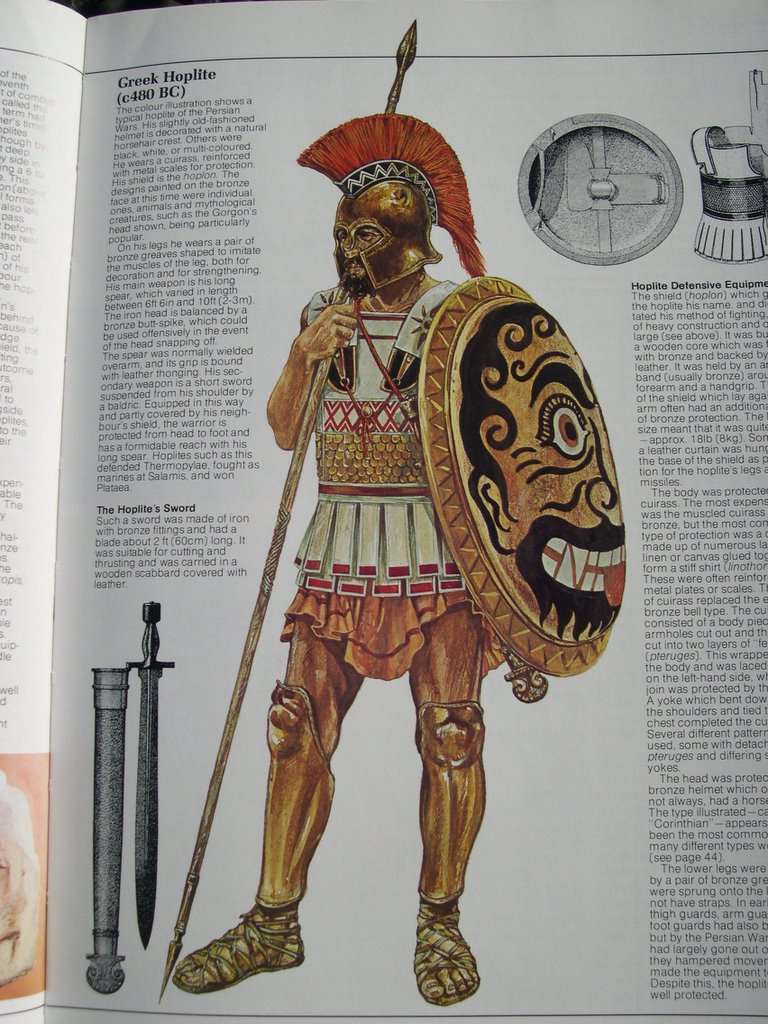 One can't help but notice that the Spartan warriors as depicted in Frank Miller's '300' are devoid of most of the armor that they would have worn during the Battle of Thermopylae in 480 B.C. Therefore, to clarify any misconceptions about their armor, here is an illustration in John Warry's book entitled 'Warfare in the Classical World' which shows how a Greek hoplite would have been armed when meeting the Persian army.
When you factor in the opressive heat of the Greek summer in August 480 B.C. along with the weight of the armor, one must marvel at the condition of these warriors. Even more astonishing is that King Leonidas was in his 50's, which would have been considerably older than the Spartiates that he was leading!
If you would like to see other illustrations like this one, please let me know.
Many thanks to Patti, Dotty & Jane. Cheers!
Thursday, November 03, 2005
Blog Number 52 - Is Zeus the inspiration behind the illustration of King Leonidas in Frank Miller's '300'?
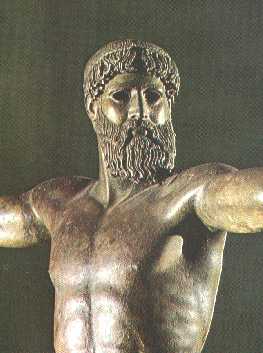
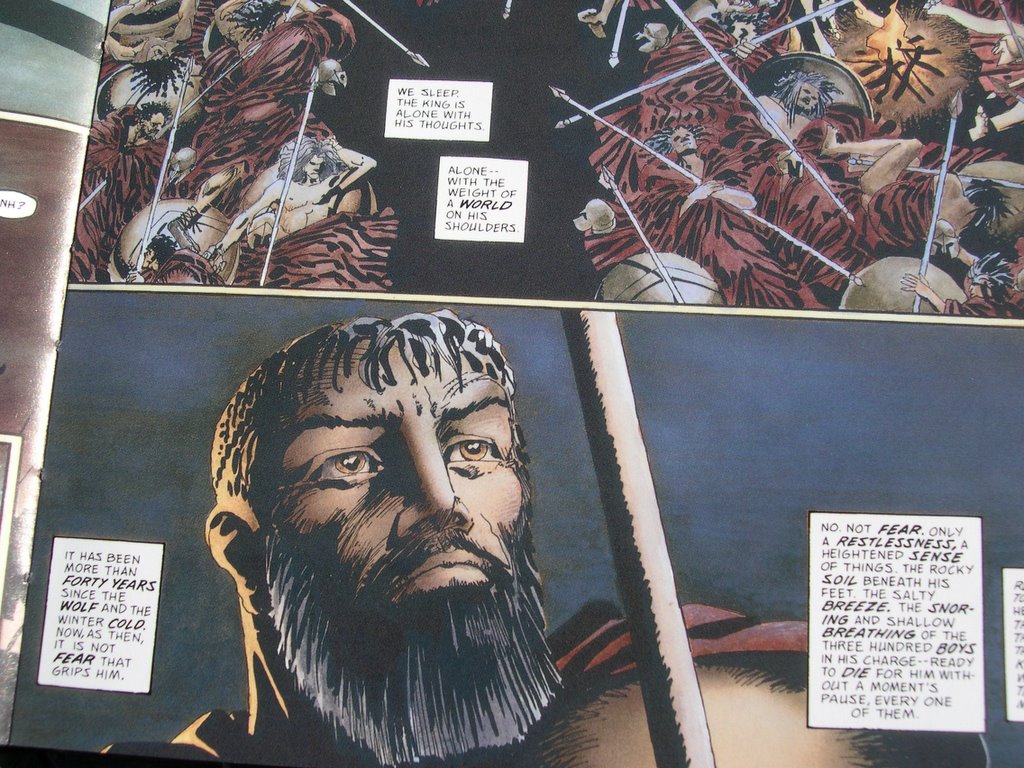
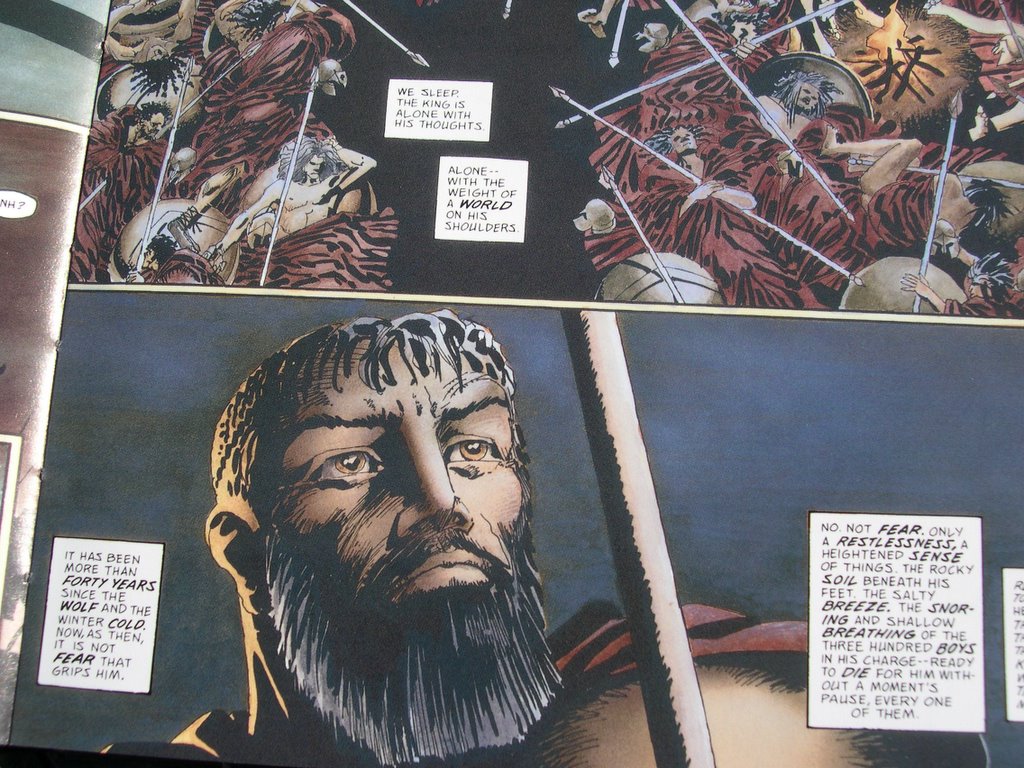

In one of my blogs that I posted last week, I wondered who Frank Miller used as an inspiration for his illustration of King Leonidas. Several days later I received a comment from Kryptes who mentioned that F.M.'s illustration of the leader of the 300 Spartans bore an uncanny resemblance to a statue of Zeus. After making a side-by-side comparison, I would have to agree that there is a huge similarity!
Therefore, it could be easy to draw a conclusion that the statue of Zeus is the basis for the illustration. I know I'm reaching here, however, a parallel can also be drawn, since Zeus was the king of the gods in Greek mythology and Leonidas was the king of Sparta.
Does it seem as if the illustration of King Leonidas could have been inspired by the statue of Zeus or is it a coincidence?
This only reinforces why I encourage comments since it can be illuminating as it was in this instance and it can provide ideas for many blogs to come.
Gracias to Kryptes!
Wednesday, November 02, 2005
Blog Number 51 - Ephialtes and eugenics in Frank Miller's '300'
The historical accounts of Sparta have recorded that a newly born child was shown to the city elders who determined if the infant was healthy or unfit to live. If not, the male children were thrown into a gorge on Mount Taygetos called the Apothetae which was known as the 'place of rejection'. The girls on the other hand were left in a basket so that there was a chance that a shepherd or anyone strolling by would take the child in.
Ephialtes (pronounced Ef-ee-ul-tez), the traitor of Thermopylae as depicted by Frank Miller in '300', is a Spartan by birth who because of his deformity was whisked away by his parents so that he wouldn't be left to his fate as the other 'sickly' Spartan children were.
Since Herodotus wrote that Ephialtes was from Malis, not Sparta and that there wasn't any mention that he was a hunchback as depicted in '300', this condundrum was most perplexing since I tried to reconcile Miller's Ephialtes as being Spartan instead of Malian. After giving it some thought, I wrote Blog Number 18 which I tried to my explain why F.M. portrayed him with the aforementioned characteristics.
Thanks to Lynne & Jane!
Ephialtes (pronounced Ef-ee-ul-tez), the traitor of Thermopylae as depicted by Frank Miller in '300', is a Spartan by birth who because of his deformity was whisked away by his parents so that he wouldn't be left to his fate as the other 'sickly' Spartan children were.
Since Herodotus wrote that Ephialtes was from Malis, not Sparta and that there wasn't any mention that he was a hunchback as depicted in '300', this condundrum was most perplexing since I tried to reconcile Miller's Ephialtes as being Spartan instead of Malian. After giving it some thought, I wrote Blog Number 18 which I tried to my explain why F.M. portrayed him with the aforementioned characteristics.
Thanks to Lynne & Jane!
Tuesday, November 01, 2005
Blog Number 50 - More cast members named in Frank Miller's '300'
A couple of months ago, when I started thinking about what would be a catchy title for this web log, I had some reservations about naming it "300 blogs about Frank Miller's '300'". I really did!!! I thought to myself, how would I be able to come up with the content that would allow me to post something 300 times without being repititious?
Well, here I am today with a milestone of sorts, writing my 50th blog and going strong! It seems as if every week there is some news filtering out of Montreal, Canada about actors named and the roles that they will be playing in '300'.
According to the IMDB, the latest news is that Englishman Tom Wisdom will be playing Astinos and stuntman David Leitch, the Hero Spartan. At some point in time, hopefully in the near future, these roles will be more defined since they don't appear as characters in '300'.
Then again, you could say that there were at least '300' Hero Spartans!!!
Well, here I am today with a milestone of sorts, writing my 50th blog and going strong! It seems as if every week there is some news filtering out of Montreal, Canada about actors named and the roles that they will be playing in '300'.
According to the IMDB, the latest news is that Englishman Tom Wisdom will be playing Astinos and stuntman David Leitch, the Hero Spartan. At some point in time, hopefully in the near future, these roles will be more defined since they don't appear as characters in '300'.
Then again, you could say that there were at least '300' Hero Spartans!!!
Subscribe to:
Posts (Atom)